SIP calculator for 10 years returns: Why You Need a SIP Right Now
A few days ago, I was sitting with my younger cousin at a local tapri, having cutting chai. He just got his first corporate job in Bangalore and was super excited. But within ten minutes, his excitement faded. He sighed and said, “Bhai, account mein salary aati hai, aur mahine ke end tak pata nahi kahan gayab ho jaati hai. Savings ke naam par zero hai. Kuch batao yaar, bina zyada tension liye paise kaise bachau?”
I looked at him, took a sip of my chai, and said just one word: SIP.
If you are an Indian millennial or Gen-Z, you’ve probably seen your favorite finance creators screaming “SIP! SIP! SIP!” on Instagram Reels or YouTube Shorts. But let’s bypass all that high-level technical noise and talk like real friends. What exactly is this thing, why is it a literal cheat-code for wealth building, and how can you use it to secure your future without giving up your weekend plans? Let’s break it down completely.

What on Earth is a SIP? (The Auto-Debit Magic)
Let’s clear up a massive misconception first: SIP is not a financial product. You don’t “buy a SIP.”
SIP stands for Systematic Investment Plan. Think of it as a behavior or a method of investing. It’s exactly like your Netflix or Spotify monthly subscription, but instead of deducting money to show you movies, a SIP automatically deducts a fixed amount from your bank account every month and invests it into a Mutual Fund.
Best SIP amount for beginners
You can start with as little as ₹500 a month. You set a date—say the 5th of every month (right after your salary hits)—and the system handles the rest. It forces you to save before you get a chance to spend it all on random Zomato orders.
The Real Magic: Compounding with a Live Example
Why do people go wild over SIPs? Because of a little math superpower called Compounding. When you invest, you earn returns. The next year, you earn returns on your original money plus the returns you earned last year. It’s like a snowball rolling down a hill, getting bigger and bigger.
SIP return calculator in rupees
Let’s look at a real-life example to see how the math actually plays out.
Imagine two friends, Rohit and Rahul, both 25 years old.
- Rohit decides to spend ₹5,000 every month on expensive cafes and gadgets.
- Rahul decides to sacrifice just one weekend party and starts a monthly SIP of ₹5,000 in an equity mutual fund.
Let’s assume the mutual fund gives an average long-term return of 12% annually (which is very standard for Indian markets over 15-20 years).
If Rahul keeps this SIP running for 20 years:
- His Total Investment: He would have put in ₹12,000,000 out of his pocket.
- The Estimated Wealth Generated: Hold your breath… his total portfolio value would grow to roughly ₹50 Lakhs!
- What if he extends it for just 10 more years (Total 30 years)? His total investment becomes ₹18,000,000, but his final wealth skyrockets to an wild ₹1.7 Crores!
That extra 10 years at the end creates over a crore of difference. That is the sheer power of starting early.
Why You Absolutely Need to Start a SIP (The Pros)
If you are still keeping your money in a traditional savings bank account earning 3% interest, you are technically losing money every day because inflation (mehengai) in India grows at around 5-6% every year. Here is why SIP is the ultimate fix:
- Rupee Cost Averaging (No Need to Market Time): People always worry, “Is the stock market too high right now? Should I wait for it to crash before investing?” With a SIP, you don’t care. When the market is high, your ₹5,000 buys fewer units of the mutual fund. When the market crashes, your ₹5,000 automatically buys more units. Over time, your cost gets averaged out smoothly. You win either way!
- Discipline Over Emotion: When the market goes down, human psychology makes us panic and sell. A SIP automates the process, removing your chaotic daily emotions from your long-term wealth.
- Extremely Flexible: You aren’t locked in forever. If you face a financial crunch, you can pause your SIP for a few months without any penalty. If you get a salary hike, you can step up and increase your monthly amount.
The Honest Truth: The Cons of SIP
Look, I am your friend, not a salesman. I won’t tell you that a SIP is a magical fairy tale with zero risks. You need to know the downsides before you jump in:
- No Short-Term Guarantees: Mutual funds are linked to the stock market. If you invest via a SIP for just 6 months or 1 year, your portfolio might show a negative balance if the market is going through a bad phase. SIPs are strictly meant for a long-term horizon (at least 3 to 5+ years).
- Not Fixed Returns: Unlike a Fixed Deposit (FD) where the bank guarantees your return percentage, mutual fund returns fluctuate based on market performance.
Which Type of SIP Should You Actually Choose?
When you log into an investing platform, you’ll see a dizzying array of options. To keep it sweet and simple, here is a basic blueprint for beginners:
- Large Cap Funds: These invest in India’s top 100 giant companies (like Reliance, HDFC, TCS). They are relatively safer and stable, making them great for conservative beginners.
- Mid & Small Cap Funds: These invest in smaller, faster-growing companies. They are highly volatile (they shake up violently during market drops), but they have the potential to give massive, aggressive returns in the long run.
- Index Funds: My personal favorite for a hassle-free life. They simply copy the Nifty 50 index. It’s safe, has low management fees, and grows along with India’s economy.
Direct vs Regular Mutual Funds

When you choose your funds, you need to understand the huge difference between direct vs regular mutual funds. Always make sure you pick the ‘Direct’ option. Regular funds involve an agent or a middleman who silently cuts a 1-2% commission from your profits every single year. It sounds tiny on paper, but over a 20-year horizon, that little leak can rob you of lakhs of rupees. Direct plans have zero commission, meaning 100% of the growth stays inside your pocket.
Stop Guessing: Calculate Your Own Future Wealth Instantly
Don’t just take my word or my example for it. Everyone has different financial goals. Maybe you want to save for a destination wedding, a house down payment, or early retirement. You need to know exactly how much you need to invest every month to hit your target.
How to calculate SIP returns manually
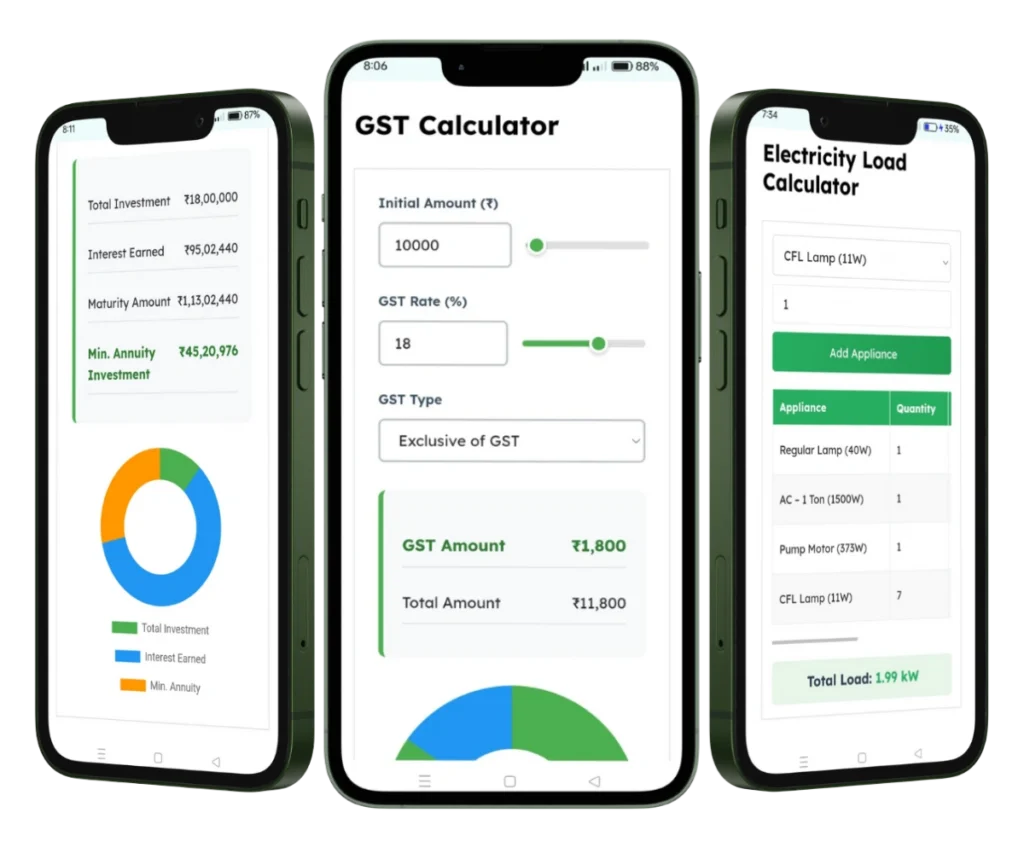
To make this super easy for you, I actually built a customized tool on my own website. You can use the Free SIP Calculator on toolist.xyz to map out your goals.
I designed it to be completely clutter-free and straightforward. You don’t need to put in your email ID or phone number, so don’t worry—no random telemarketers will call you trying to sell you policies. Just adjust the sliders for your monthly investment amount, expected return rate, and the number of years, and it will instantly show you your potential future wealth with a clean visual breakdown. Go play around with the numbers and see what your future looks like!
Power of Compounding Examples
Looking at real-world power of compounding examples is always mind-blowing. Let’s say you start a SIP of ₹5,000 at age 25. At an average 12% return, you’ll accumulate around ₹50 Lakhs by the time you turn 45. But here is the crazy part: if you don’t touch that money and let it run for just 10 more years until you turn 55, your portfolio doesn’t just add a few lakhs—it skyrockets straight to over ₹1.7 Crores! That extra decade of waiting creates a staggering difference.
Where Should You Open a SIP? (Top Indian Platforms)
Back in the day, you had to physically sign papers and submit them to a broker. Today, you can start a SIP from your phone in less than 5 minutes using safe, SEBI-registered discount broking apps. Here are the most reliable platforms in India right now:
- Groww / Coin by Zerodha: Super clean user interfaces, completely free to use for “Direct” mutual funds (which means zero hidden commission cuts go to middlemen).
- Angel One / Upstox: Great if you want a platform that handles both mutual funds and active stock trading in one single account.
Best Discount Brokers for SIP
Gone are the days when you had to visit a local bank branch and fill out stacks of physical paperwork just to start investing. Today, the best discount brokers for SIP in India—like Groww or Zerodha (Coin)—let you open a completely free account from your smartphone in less than 5 minutes. Their user interfaces are incredibly simple, and they allow you to set up your monthly auto-debit completely hassle-free with zero hidden platform charges.
What should you Do
The hardest part of building wealth is not picking the perfect fund—it’s simply pressing the start button. Most people keep waiting for the “perfect time” to invest, and before they know it, five years have passed.
Remember: The best time to start a SIP was yesterday. The second best time is today.
Take control of your salary before it vanishes into thin air again. Head over to toolist.xyz, run your numbers on the calculator to find an amount you are comfortable with, set up your auto-debit, and let the compounding engine build your dream life while you sleep!
Frequently Asked Questions (FAQs)
1. Can I stop my SIP anytime?
Yes, absolutely! This is your own hard-earned money, not some rigid legal contract. If you ever hit a tight spot or just want to take a break from investing for a few months, you can pause or completely stop your SIP with a single click inside your investment app. The mutual fund house will not charge you any penalty or fine. Whenever you are financially ready again, you can just start a new one.
2. What happens if I miss one monthly SIP?
Don’t panic—nothing terrible happens, and nobody is going to lock your account. If your bank balance is low on the auto-debit date and your SIP bounces, the fund house simply skips that month’s investment. However, do note that your local bank might charge you a small standard mandate failure fee (usually around ₹200 to ₹300) for the bounced auto-debit. If you miss three consecutive months, your SIP gets automatically cancelled, but your existing money stays safe in the fund.
3. Is ₹500 SIP enough for 20 years?
As the old saying goes, “Little drops of water make a mighty ocean.” If you invest just ₹500 every single month for 20 years, your total out-of-pocket investment will be ₹1.2 Lakhs. But thanks to long-term compounding at an average 12% annual return, your final amount will grow to roughly ₹5 Lakhs! While ₹500 is a fantastic starting point for beginners, a smart trick is to increase your SIP amount by 10% every year as your income grows.
4. What is the SIP vs Monthly Mutual Fund difference?
This is a massive point of confusion on the internet, but let’s clear it up once and for all: there is zero difference. They are the exact same thing! A Mutual Fund is the actual basket where your money gets invested, and a SIP (Systematic Investment Plan) is simply the automatic, monthly method you use to put money into that basket.
I hope this blog post is helpful for you
Thank you 😊